Soccernomics
Intro
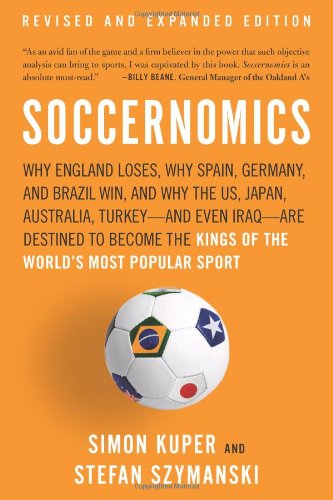
Soccernomics authors Simon Kuper and Stefan Syzmanski, pull back the cover on the English Premier League and the other European professional soccer leagues. Kuper, a journalist, and Szymanski, an economics professor and international sports expert, dig deep into English and European professional soccer statistics.
They approach professional soccer with both an economist’s eye and a journalist’s sleuthing ability, uncovering widely-held, false beliefs about soccer that perpetuate themselves into gospel truths. Soccernomics was first released in 2009 and has turned into a Soccernomics book series and franchise of sorts, dissecting numerous topics at the intersection of soccer and statistics. The books are pumped out about one every couple soccer seasons.
I listened to the audio version of Soccernomics while traversing Wyoming via I-80 which was very helpful in passing the time and is much better than the alternative method of trying to stay awake while driving across Wyoming — piercing your eyelids with toothpicks.
Similar to Michael Lewis’s book Moneyball, the authors show how professional soccer has failed to use empirical data to make financial decisions in terms of purchasing players and club business decisions… mistakes that are slowly starting to change in professional soccer.
From an American’s point-of-view Soccernomics is helpful in understanding the history of English and European soccer, the mentality of club owners and managers, and why although wildly popular, professional English and European soccer clubs struggle financially. The book also portends the future of world-wide professional soccer and which countries will grow to dominate the sport.
I will list the parts of the book that (as an American) were most enlightening to me and then give a synopsis of each
1. GDP, population, historical experience determine soccer success
Once Simon Kuper and Stefan Szymanski share the formula for national soccer success, it is as obvious as simple arithmetic.. It makes sense that a country’s economic production, large population, continued population growth, and a long history of soccer, play a part in its success.
Countries with large economic engines have excess capital to spend on building stadiums, building training facilities, and developing players. High economic output also means that there is enough food to go around so future athletes will grow up with proper nutrition.
Countries with large and growing populations have large pools of potential young soccer athletes from which to draw. A comparison every American is familiar with is noting the differences in the teams a rural high school is able to field compared to a large suburban high school. The large suburban high school has a much larger talent pool from which to draw.
A country’s shared knowledge of soccer can run very deep. Many countries’ soccer history runs over 140 or 150 years into the past. In these countries there is a deep, collective knowledge of the game, the best tactics, and fertile ground for producing professional athletes and managers. There is also a national sense of pride within the citizenry for the country’s place in international soccer history.
2. Why Western Europe dominates in international play
Simon Kuper and Stefan Szymanski credit knowledge networks to Western Europe’s domination of international soccer. They theorize that the reason the European continental teams grew and became technically better than the English clubs is that the continental European clubs were better connected, allowing for easier knowledge transfer due to European cities’ proximity to each other. The authors cite the 2006 World Cup. A traveler could fly within a 2.5 hour flight of Germany to 20 countries comprising a total population of 300 million people. The entire population of England is only a little over 67 million.
When the Germans were struggling with their game, they looked to Spanish and Dutch teams to find a solution and how they could assimilate it into what they were doing. The authors quote Pep Guardiola stating, “Ideas are for everyone and I have stolen a lot that I could.”
When an innovative club or player would come up with a new trick or field tactic, the new knowledge would be recognized and emulated. Players were always being traded back-and-forth among the European teams and would teach their knowledge and skills to new team mates. Club managers would be sacked and take the knowledge they learned at one club with them to their new job not just to a neighboring town, but most likely a short distance across an international border.
3. Racism and discrimination in English and European soccer clubs
Americans tend to think of racism as being unique to the history of American professional sports. Think Jackie Robinson breaking the color barrier in professional baseball. However, the authors statistically prove the history of discrimination in English and European profession soccer owing to the lack of minority players in professional clubs. Simon Kuper and Stefan Szymanski also detail the terrible treatment minority players received at the hands of club owners, managers, fellow teammates, fans, and journalists.
As the great colonial empire countries’ started to break up and achieve independence, many minority groups moved to England and their other imperial mother countries in search of better opportunities. These minority groups tended to emigrate to the countries who shared their same language and recognized their citizenship with friendly immigration policies.
4. Children growing up in poor countries aren’t destined to be shut out of soccer success
Children from poor neighborhoods within poor countries, but who are otherwise healthy — can become very successful professional soccer players. The authors give Ronaldo, Ibrahimovic, and Diego Maradona as examples.
These were kids from poor families, from poor countries. But because they hailed from poor families it actually gave them an advantage. Due to their humble and cramped living conditions, it meant their children spent several hours every day on the streets playing soccer with their mates and honing their play. This was very much the case of kids growing up playing in the empty lots of post World War II England and Europe.
5. Why Soccer clubs make bad business decisions, lose money, and why it doesn’t matter
At the highest levels of American professional sports teams financially imploding and going bankrupt is fairly uncommon. The franchise system has backstops and profit sharing agreements in place to help keep teams financially healthy or at least keep them from going deep into the red.
The European system has no such backstops in place. European soccer teams are known for their heavy, unmanageable debt, and being on shaky financial ground.
The big financial winners are the players. The best professional soccer players are highly coveted. Clubs — capitulating to fan pressure or an executive’s ego — chase sought-after players offering inflated salaries and signing bonuses often at the detriment of club finances.
Why do these financial woes not really matter that much? Simon Kuper and Stefan Szymanski exhibit that interestingly, over the 160 plus years of soccer clubs existence, very few have actually gone bust and sent into receivership never to return. This is especially true of clubs who have achieved a league’s highest levels. If a club does fall into financial straits, it can always reduce its wages, cut expenses, sell expensive players, and play down a division where players’ wages are much cheaper.
Outside of the US (and even sometimes in the US), soccer clubs aren’t necessarily meant to be large cash producing enterprises for their owners. In years past, clubs weren’t bought as money making machines, most owners were lucky if the club broke even and didn’t have to pour resources into the club. Recently however, many soccer clubs have been seen as undervalued. Many financial consortiums purchase a club because they know they can increase revenues through television rights, merchandising, and other revenue centers as the appetite for soccer continues to grow world-wide. As the revenues grow, so does the value of the business. This makes soccer club ownership not necessarily a good investment from a cash generating standpoint, but certainly a good investment from an appreciation standpoint.
6. The Future Map of Global Soccer
Soccer is now becoming more popular in countries such as China and India who have growing middle class populations who are hungry for sport and entertainment, growing economies with enough food to feed their growing populations. These countries are doing a better job providing modern healthcare to their citizens, including a generation of promising young soccer athletes who will not be unhealthy and malnourished as were their parents and grandparents’ generations. The governments, in an effort to increase their standing in the world’s eyes, will spend enormous amounts of money on stadiums and youth soccer programs.
Soccer is being embraced by countries who have been indifferent to soccer. As people look for new avenues of sports entertainment, countries such as Japan, the United States, and Australia are looking to soccer to fill a need for new and novel sports to captivate the public’s interest. The citizens of these countries have strong middle classes with lots of extra discretionary money to spend on sports and entertainment.
In the coming decades China, United States, Australia, and Japan will start to overtake European nations as fertile ground for soccer innovation and growth.
Simon Kuper and Stefan Szymanski do a great job in dispelling many myths and traditional group think that has plagued soccer since its early days. They do this through careful statistical analysis and presenting facts with lots of research to back up their assertions.
I found this book very interesting and enlightening in several areas. However, parts can be statistically dense and you may want to flip past the statistic-heavy pages (or fast forward like I did) to get to the lighter, more contextual parts. I look forward to reading more Soccernomics books and learning what they have to say about the world’s fastest growing sport.