
Blog

Soccernomics book review from an American’s Point-of-view

Soccernomics

Intro

Soccernomics authors Simon Kuper and Stefan Syzmanski, pull back the cover on the English Premier League and the other European professional soccer leagues.  Kuper, a journalist, and Szymanski, an economics professor and international sports expert, dig deep into English and European professional soccer statistics.

They approach professional soccer with both an economist’s eye and a journalist’s sleuthing ability, uncovering widely-held, false beliefs about soccer that perpetuate themselves into gospel truths.  Soccernomics was first released in 2009 and has turned into a Soccernomics book series and franchise of sorts, dissecting numerous topics at the intersection of soccer and statistics.  The books are pumped out about one every couple soccer seasons.

I listened to the audio version of Soccernomics while traversing Wyoming via I-80 which was very helpful in passing the time and is much better than the alternative method of trying to stay awake while driving across Wyoming — piercing your eyelids with toothpicks.

Similar to Michael Lewis’s book Moneyball, the authors show how professional soccer has failed to use empirical data to make financial decisions in terms of purchasing players and club business decisions… mistakes that are slowly starting to change in professional soccer.

From an American’s point-of-view Soccernomics is helpful in understanding the history of English and European soccer, the mentality of club owners and managers, and why although wildly popular, professional English and European soccer clubs struggle financially.  The book also portends the future of world-wide professional soccer and which countries will grow to dominate the sport.

I will list the parts of the book that (as an American) were most enlightening to me and then give a synopsis of each

1.   GDP, population, historical experience determine soccer success

Once Simon Kuper and Stefan Szymanski share the formula for national soccer success, it is as obvious as simple arithmetic..  It makes sense that a country’s economic production, large population, continued population growth, and a long history of soccer, play a part in its success.

Countries with large economic engines have excess capital to spend on building stadiums, building training facilities, and developing  players.  High economic output also means that there is enough food to go around so future athletes will grow up with proper nutrition.

Countries with large and growing populations have large pools of potential young soccer athletes from which to draw.  A comparison every American is familiar with is noting the differences in the teams a rural high school is able to field compared to a large suburban high school. The large suburban high school has a much larger talent pool from which to draw.

A country’s shared knowledge of soccer can run very deep.  Many countries’ soccer history runs over 140 or 150 years into the past.  In these countries there is a deep, collective knowledge of the game, the best tactics, and fertile ground for producing professional athletes and managers.  There is also a national sense of pride within the citizenry for the country’s place in international soccer history.

2.  Why Western Europe dominates in international play

Simon Kuper and Stefan Szymanski credit knowledge networks to Western Europe’s domination of international soccer.  They theorize that the reason the European continental teams grew and became technically better than the English clubs is that the continental European clubs were better connected, allowing for easier knowledge transfer due to European cities’ proximity to each other.  The authors cite the 2006 World Cup.  A traveler could fly within a 2.5 hour flight of Germany to 20 countries comprising a total population of 300 million people.  The entire population of England is only a little over 67 million.

When the Germans were struggling with their game, they looked to Spanish and Dutch teams to find a solution and how they could assimilate it into what they were doing.   The authors quote Pep Guardiola stating, “Ideas are for everyone and I have stolen a lot that I could.”

When an innovative club or player would come up with a new trick or field tactic, the new knowledge would be recognized and emulated.  Players were always being traded back-and-forth among the European teams and would teach their knowledge and skills to new team mates.  Club managers would be sacked and take the knowledge they learned at one club with them to their new job not just to a neighboring town, but most likely a short distance across an international border.

3.  Racism and discrimination in English and European soccer clubs

Americans tend to think of racism as being unique to the history of American professional sports.  Think Jackie Robinson breaking the color barrier in professional baseball.  However, the authors statistically prove the history of  discrimination in English and European profession soccer owing to the lack of minority players in professional clubs. Simon Kuper and Stefan Szymanski also detail  the terrible treatment minority players received at the hands of club owners, managers, fellow teammates, fans, and journalists.

As the great colonial empire countries’ started to break up and achieve independence, many minority groups moved to England and their other imperial mother countries in search of better opportunities.  These minority groups tended to emigrate to the countries who shared their same language and recognized their citizenship with friendly immigration policies.

4.  Children growing up in poor countries aren’t destined to be shut out of soccer success

Children from poor neighborhoods within poor countries, but who are otherwise healthy — can become very successful professional soccer players.  The authors give Ronaldo, Ibrahimovic, and Diego Maradona as examples.

These were kids from poor families, from poor countries.  But because they hailed from poor families it actually gave them an advantage.  Due to their humble and cramped living conditions, it meant their children spent several hours every day on the streets playing soccer with their mates and honing their play.  This was very much the case of kids growing up playing in the empty lots of post World War II England and Europe.

5.  Why Soccer clubs make bad business decisions, lose money, and why it doesn’t matter

At the highest levels of American professional sports teams financially imploding and going bankrupt is fairly uncommon.  The franchise system has backstops and profit sharing agreements in place to help keep teams financially healthy or at least keep them from going deep into the red.

The European system has no such backstops in place.  European soccer teams are known for their heavy, unmanageable debt, and being on shaky financial ground.
The big financial winners are the players. The best professional soccer players are highly coveted.  Clubs — capitulating to fan pressure or an executive’s ego —  chase sought-after players offering inflated salaries and signing bonuses often at the detriment of club finances.

Why do these financial woes not really matter that much?  Simon Kuper and Stefan Szymanski exhibit that interestingly, over the 160 plus years of soccer clubs existence, very few have actually gone bust and sent into receivership never to return. This is especially true of clubs who have achieved a league’s highest levels.  If a club does fall into financial straits, it can always reduce its wages, cut expenses, sell expensive players, and play down a division where players’ wages are much cheaper.

Outside of the US (and even sometimes in the US), soccer clubs aren’t necessarily meant to be large cash producing enterprises for their owners.  In years past, clubs weren’t bought as money making machines, most owners were lucky if the club broke even and didn’t have to pour resources into the club.  Recently however, many soccer clubs have been seen as undervalued. Many financial consortiums purchase a club because they know they can increase revenues through television rights, merchandising, and other revenue centers as the appetite for soccer continues to grow world-wide.   As the revenues grow, so does the value of the business.   This makes soccer club ownership not necessarily a good investment from a cash generating standpoint, but certainly a good investment from an appreciation standpoint.

6.  The Future Map of Global Soccer

Soccer is now becoming more popular in countries such as China and India who have growing middle class populations who are hungry for sport and entertainment, growing economies with enough food to feed their growing populations.  These countries are doing a better job providing modern healthcare to their citizens, including a generation of promising young soccer athletes who will not be unhealthy and malnourished as were their parents and grandparents’ generations.    The governments, in an effort to increase their standing in the world’s eyes, will spend enormous amounts of money on stadiums and youth soccer programs.

Soccer is being embraced by countries who have been indifferent to soccer.  As people look for new avenues of sports entertainment, countries such as Japan, the United States, and Australia are looking to soccer to fill a need for new and novel sports to captivate the public’s interest.   The citizens of these countries have strong middle classes with lots of extra discretionary money to spend on sports and entertainment.

In the coming decades China, United States, Australia, and Japan will start to overtake European nations as fertile ground for soccer innovation and growth.

Simon Kuper and Stefan Szymanski do a great job in dispelling many myths and traditional group think that has plagued soccer since its early days.  They do this through careful statistical analysis and presenting facts with lots of research to back up their assertions.

I found this book very interesting and enlightening in several areas.  However, parts can be statistically dense and you may want to flip past the statistic-heavy pages (or fast forward like I did) to get to the lighter, more contextual parts. I look forward to reading more Soccernomics books and learning what they have to say about the world’s fastest growing sport.

Inverting The Pyramid The History of Football Tactics book review and connections to the Spirit of Excellence

Inverting The Pyramid The History of Football Tactics by Jonathan Wilson.  This review’s first half discusses soccer’s humble beginnings and interesting historical facts. The second half discusses soccer managers who were innovative, making soccer the universally loved sport it is today.  Connections to these managers’ philosophies and the similarities to the Spirit of Excellence and SPoX Coaching program are highlighted. 

Soccer’s Macho Beginnings

In the early days, before there were the official sports of football or soccer there was a game whose rules were yet to be codified.  Although the rules weren’t 100% universally understood, what was understood is that there was very much a macho aspect to the game.

Before soccer shin guards became part of every player’s kit there was something called “hacking” which is when a player would kick an opponent repeatedly in the shins until they relented and gave up the ball.  When a player would receive the ball, he would make a mad dash, dribbling down field, charging the goalkeeper.  No attempt to pass was made because apparently this act made you to be “less of a man” in the eyes of your fellow players. Interestingly, it was the Scots who first introduced the idea of passing the ball to a fellow teammate. 

This early soccer predecessor started in English colleges and was very popular among students.  However, the game was played differently at different universities.  At Eton, the game was played by kicking the ball down the field, while in Rugby, a college town in the West Midlands area of England, the ball was carried and ran down the field towards the goal.

Football or what would be called Association Football (Soccer) and Rugby officially split in 1863.  Later Rugby split again into Rugby Union and Rugby League.  American Football has its roots in Rugby as well.  In order to score a goal in Rugby, the player has to cross the goal line or “try line” and literally touch the ball down onto the grass – hence the American Football term “touch down.”  Just as in Rugby, during the early days of American Football it was illegal to throw the ball forward to a teammate, completing a forward pass.

As school boys quickly matured into employees of the 19th century Victorian industrial age, the game soon spread to industry and the working class.  

British colonialism spread the game throughout the British realm and even to countries who weren’t part of the realm, thanks to British industrial concerns such as mining, banking, and engineering.  The local populace in places like Argentina, Austria, and Brazil were introduced to the game through British company teams.  

True to rigid English notions about socio-economic hierarchy,  the company teams were very stratified along economic and racial lines.  Ethnic locals weren’t allowed to play on the English teams, but they soon started their own teams and each country developed their own style of play.   

It is clear that the innovative technique of the bicycle kick was used over 100 years ago, but who invented it isn’t quite as clear.  Some say it was the Argentines, others say it was the Brazilians, and still others say it was a Chileano who pioneered the technique.  However, what is extremely clear and accepted is that it wasn’t the English who invented it.   Inverting the Pyramid, page 50

If the English invented the game, why weren’t the English the ones to innovate it?  It took players from nations who weren’t concerned with conventionality and conforming to certain norms  to think up new and innovative ways to play the game and to play it more efficiently.

The author goes through a myriad of players and coaches in order to trace the history of on-pitch formations and tactics through many different countries and three different centuries of soccer play.  The book starts with the very beginnings of soccer up to the modern players and coaches with whom we are all familiar.  The author discusses the pantheon of professional soccer gods who are recognized by the use of only one name: Cruyff, Guardiola, Klopp, Pele, Neymar, Messi, and Ronaldo.

The author traces the lineage of our modern day soccer heroes to their predecessors whose philosophies still affect soccer play today. 

In between history lessons and endless discussions of coach tactical player formations, is something that I found extremely valuable and something that helped reinforce the philosophy of the Spirit of Excellence.

I’ll share some examples of historical philosophies that are the basis of the Spirit of Excellence and SPoX Coaching.   

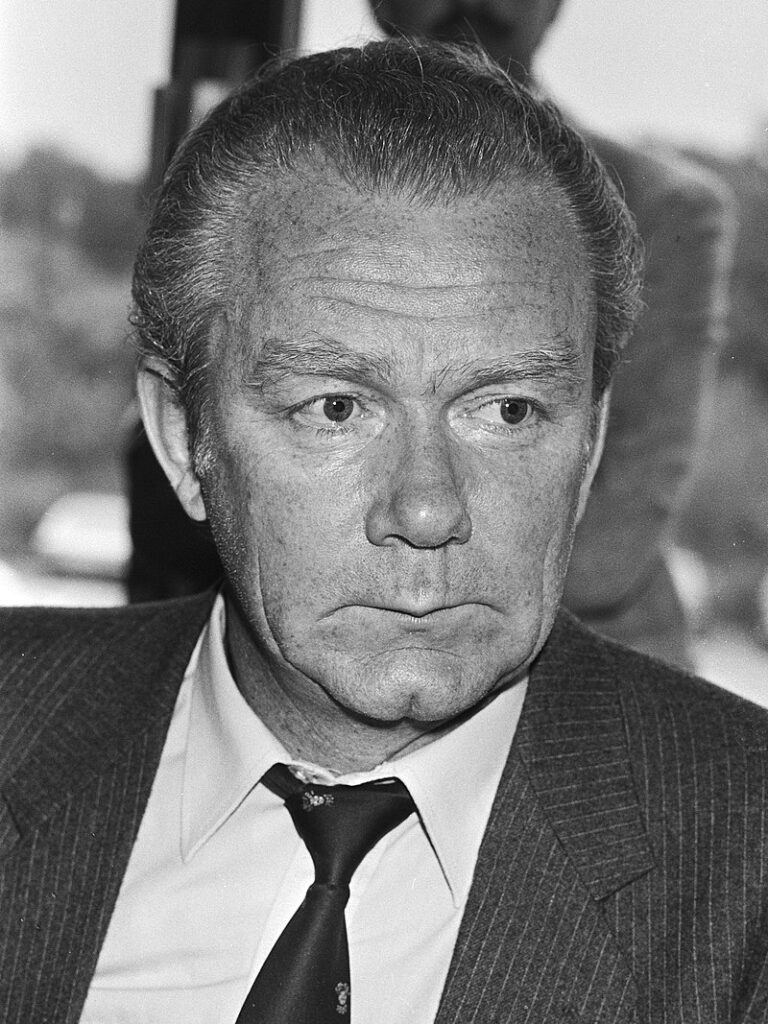
The author, Jonathan Wilson, spends quite a bit of time detailing and analyzing the management styles and philosophies of Cesar Luis Menotti, Rinus Michaels, Viktor Maslov, Valiery Lobanovskyi, Arriga Sacchi, and Jorge Valdano.  He cites Viktor Maslov, Michels, Lobanovskyi, and Sacchi for their tactical prowess that led to their coaching success while showcasing Menotti and Valdano for their philosophical attitudes which led to their coaching success.   Viktor Maslov gets recognition for being an innovative tactician and coach who could reach his players emotionally and inspire them to greatness.

Jonathan Wilson credits Michaels and Lobanovskyi for pioneering the modern version of Total Football where players are expected to know every position and to not just specialize in one position.  He recognizes Sacchi for implementing Total Football successfully with his teams.    He hails all three coaches for their modernity or a word more used by Americans would be innovation.

In particular, I’d like to highlight the philosophies of Menotti, Maslov, Lobanovsky and Sacchi because they encapsulate the philosophy of the Spirit of Excellence.

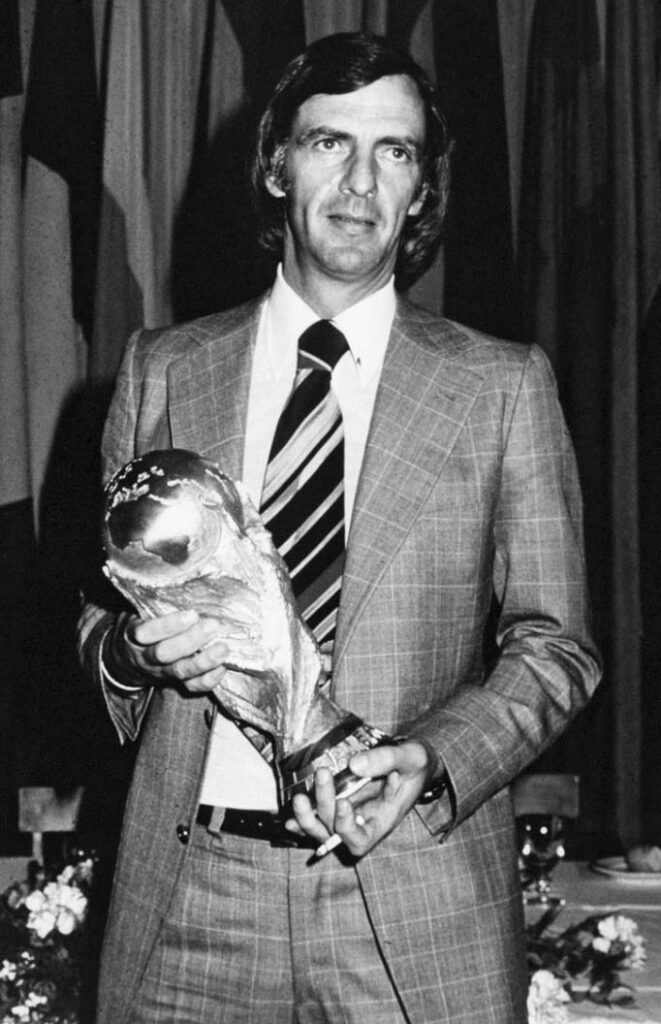
Cesar Luis Menotti

World Cup winning manager Cesar Luis Menotti.

Cesar Luis Menotti was a successful Argentine manager who was known for his long hair, Bohemian lifestyle, and pragmatic philosophies.  Menotti: And for those who say that winning is the only thing, I want to warn them that someone always wins. Therefore, in a 30 team championship, there are 29 who must ask themselves, What did I leave at this club? What did I bring to my players? What possibility of growth did I leave to my footballers? 

Inverting the Pyramid chapter 18.

This is very much the Spirit of Excellence.  You always play to win, but remember that losing a soccer match is also a part of winning, just as winning is a part of winning a soccer match.  The fact that Wilson uses Menotti’s quote shows that while one coach may be boasting, “This year I brought a title and a trophy to this club.” Wilson shows Menotti’s ability to make managers look inward. Menotti takes the opportunity to give managers a chance to reflect on their jobs.

These are the questions a coach who espouses the Spirit of Excellence philosophy would ask:

How have I made this club better?  

What of myself did I share with my players?  

In what ways have I given my players opportunities for growth not only in their soccer skills, but also growth as a person? 

Viktor Maslov

Maslov may well be considered one of the fathers of modern football in terms of tactics and .  As he made human connections to his players and they viewed him as inspiring.

Inverting the Pyramid, page 18

His pre-match instructions lasted no more than five minutes…  but he was always precise in telling us how to counteract their strengths. He would always finish with an aphorism to touch our hearts: “Today you must be strong like lions, fast like stags, agile like panthers!” And we would always do our best.

Inverting the Pyramid, page 182

Consultation was a key part of the Maslov method. The evening before games he would gather his squad together — or the senior players at least — to talk through the next day’s match, canvassing their thoughts before drawing up his final game plan. It was that level of trust and mutual understanding that allowed Maslov to implement his more radical tactical innovations.  And they were radical, almost incomprehensibly so in the context of the times.

Inverting the Pyramid, page 183

As a coach, taking the time and effort to build relationships with your team members and to offer some inspirational words goes a long way to build players’ trust in their coach.  Building trust in a coach, in turn, allows players to build trust in each other, and will allow a team to achieve success.

The radical tactical soccer innovations of Viktor Maslov:

– When the rest of the world was using the WM and 4-2-4 formations, Maslov invented the 4-4-2.

– After watching the Brazilian team’s success, he pulled back his forward. He then went the extra step and pulled back the right winger too.

– Maslov withdrew his wingers in such a way that it did not impinge upon his sides creative capacity.

Inverting the Pyramid, page 184

Valeriy Lobanovskyi 

Valeriy Lobanovskyi

Valeriy Lobanovskyi grew up in Ukraine and was trained as a scientist.  He was the first to come to the game with a scientific mind and approach. 

In him was acted out the great struggle between individuality and system:  the player in him wanted to dribble, to invent tricks, and to embarrass opponents, and yet, as he later admitted, his training at the Polytechnic Institute drove him to a systematic approach, to break down soccer into its component tasks.  Soccer, he explained, eventually became a system of twenty-two elements — two subsystems of eleven elements — moving within a defined area (the field) and subject to a series of restrictions (the laws of the game).  If the two subsystems were equal, the outcome would become a draw.  If one was stronger, it would win. Inverting the Pyramid, page 262

The efficiency of the subsystem is greater than the sum of the efficiencies of the elements that compose it.  

Inverting the Pyramid, page 263

What Lobanovskyi is describing here is what will later become known as synergy.  The Spirit of Excellence Coaching program recognizes the synergy created by individuals as they come together to create a soccer team and the unexpected success synergy can create.

Soccer, he concluded, was less about individuals than about coalitions and the connections among them.  “All life,” as he later said, “is a number.” Inverting the Pyramid, page 262

The above passages exemplify Lobanovskyi as the true scientist he was..  

It is interesting that when an idea’s time has come, people in desperate places start thinking about how to implement it.  At about the same time Rinus Michels was conceiving Total Football  Lobanovskyi was working with the idea of all players pressing

Although Lobanovskyi brought the scientific method to soccer, he also understood humans and human emotion.  An interesting quote is provided on his Wikipedia page.. 

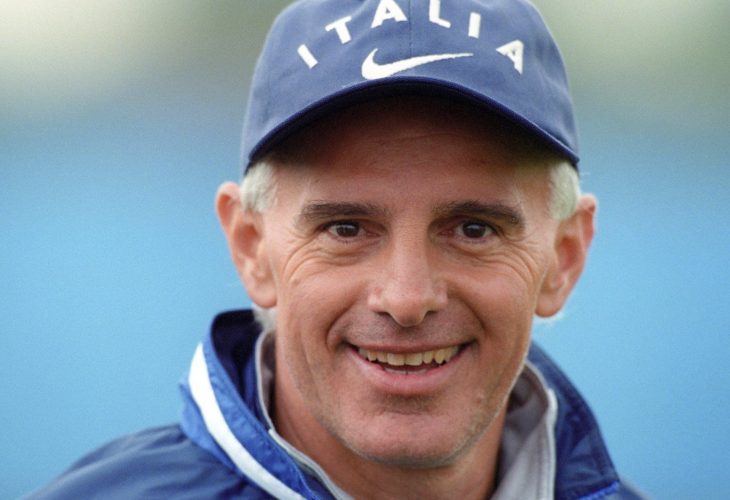
Arriga Sacchi

Arrigo Sacchi successful soccer manager

Sacchi was known for his strict training regime and practice.  He wanted his players to understand the importance of self-discipline.  

A disciple of Valeriy Lobanovskyi and Rinus Michels, Sacchi believed in every soccer player understanding every role and action required of every player on the pitch.   

He (Sacchi) wanted to see not merely the man on the ball, not merely what most would consider the center of the action, but also the rest of the team; he approached the conclusion Valeriy Lobanovskyi had come to, that the man out of possession is just as important as the man with possession, that soccer is not about eleven individuals but about the dynamic system made up of those individuals.  Inverting the Pyramid, page 357.

The Spirit of Excellence starts with the recognition that every player has unique abilities and how each player’s individual contribution fits into the greater system that makes team success.  The irony is that as a player seeks to contribute her personal talents and individuality, she must sacrifice what is best for herself, giving deference to what is best for the team.  This is where many would-be great players lose sight of the mission and don’t achieve the greatness they could have if they had only put the team’s success above their own. 

Sacchi believed in the importance of emotion to the game of soccer.  The emotions not just of athletes, but of the fans.

I wanted to give 90 minutes of joy to people.  And I wanted that joy to come not from winning, but from being entertained, from witnessing something special… A good manager is both screenwriter and director.  The team has to reflect him.  Inverting the Pyramid, page 358.

Josef Lenhart, father of the Spirit of Excellence, knows the importance of emotion and its role in sport. So much so that his company Sporteo International’s tagline is “Winning Emotions.” Josef believes passion, team spirit, and striving for personal excellence all are part of creating Winning Emotions within a soccer team, a business, a family, or any organization where people depend on each other to achieve success.

Winning Emotions are also conveyed to the fans both in the stadium and at home. Feeling emotions is the reason people bother to watch the game at all.  

Jonathan Wilson cites retired Argentine professional soccer player and former Real Madrid manager Jorge Valdano, stating:

At the heart of football’s great power of seduction is that there are certain sensations that are eternal.  What a fan feels today thinking about the game is at the heart of what fans felt fifty or eighty years ago.

Inverting the Pyramid, page 358

Although soccer play has evolved, the emotions connected to it are age-old — the exhilarating excitement of winning — the heart-crushing feeling of defeat, love for some players, and the hate of others are as old as sport itself.

In Inverting the Pyramid The History of Football Tactics Jonathan Wilson does an incredible job of researching players and managers to give us an understanding of their history, psychology, and how those led to their soccer success.  The Spirit of Excellence provides the perfect framework to help explain what made these players and managers achieve incredible soccer success and how you can emulate their qualities to find your own success.  

DISC personality styles and the 4-4-2

by

Tyler Archibald & Ryan Windley

Each field position of a soccer formation has a unique set of responsibilities. In order for a team to have success on the pitch, each player’s personality must embody the requirements of the position played.

Using the DISC personality style model as a framework, a coach can match a player’s personality to the requirements and demands of each field position and dramatically increase both player satisfaction and team success.     

*Please note. Just as in everyday life every personality style can bring success to any job, every behavioral type can bring success to each position on the pitch. Just because a “D” wants to lead the team doesn’t mean he/she will be a good leader.  Maybe the “S” player through listening can make each player feel supported and valued allowing an esprit de corps that lifts the entire team.  Certainly the “S”  leader will have to take a page from the “D” playbook and learn when to push teammates harder in certain circumstances.  However, we all know examples of silent, supportive leaders who don’t raise their voices and get emotional, who are able to achieve extraordinary results.

D-Dominant/Driver

“D’s” want to dominate a situation.  They drive teammates hard and demand a lot of both their teammates as well as themselves.   Players with high “D” scores naturally have nerves of steel.  “D’s” killer instinct gives them an extreme sense of confidence and feel they can carry the entire team on their own shoulders 

On a soccer pitch “D’s” are genetically wired for two positions… striker or keeper.  Both of these positions require nerves of steel and the ability to face down foes.  “D’s” don’t necessarily love being in the spotlight, as much as they enjoy controlling the game and feeling that they are singularly triumphing over their foes, both of which get them into the spotlight.  “D’s” are task focused and have the ability to intensely focus on the task at hand.  Once the D has their prey in sight, they become singularly focused and can get tunnel vision, forgetting the positions of their fellow teammates and the opposing side.    

I – Influence/Inspirational

“I’s” want to influence others and look good doing it. “I’s” crave recognition and popularity.   “I’s” are valuable in a game because they have the ability to influence other players by bringing enthusiasm  to the team.  “I’s” also enjoy being creative and coming up with creative solutions to problems.  After a shot has been blocked,  “I’s” are good at creating plays and getting the ball back to the striker for another opportunity. 

Because “D’s” and “I’s” are both by default action-oriented, they work well as attacking midfielders because they have to take the initiative to make opportunities happen.  

S-Steady/Supportive 

 “S’s” love to support their fellow players.   As opposed to “D’s” and “I’s”, “S’s” do not want or feel the need to be in the spotlight.  They are very happy playing a supporting role in helping the team win.  Because of their steadiness, “S’s” are even-tempered and don’t get emotionally high and therefore don’t get emotionally low either.  “S’s” are very dependable and pride themselves on their reliability.  “S’s” have the uncanny ability to find the straightest line between two points.  If there is an easier way to complete a task, the S will find it. 

C – Cautious/Competent

A high “C” player is organized and loves detail.  They analyze obstacles and then work systematically to overcome the obstacles they have identified.  “C’s” love data and logical decision making.   “C’s” will analyze data they see in real time on the pitch and then construct mental models of the field, players, and evaluate possible scenarios that may play out.  “C’s” hold themselves to a high level of logical rigor in their decision making process. They recognize and respect logic and competence when they see it in  others.   

Both “S” and “C” are thinking oriented.  They need time to process, analyze and then react to a situation.  S and “C’s” need to have time to think before acting.  They typically do this  best in the mid or backfield position. 

DISC in professional futbol

In order to help illustrate the types of play we’re discussing, let’s examine the gameplay of professional players who have achieved superstar status.  I don’t know if these players have ever taken the DISC assessment.  If assessed, their individual results may not even match the DISC styles I’m attributing to them, but by viewing each player’s gameplay through the DISC lens, we’re able to illustrate our point.  

D-Dominant/Driver

An example of a player with a “D” style of play would be Zlatlan Ibrahimivic.  Known for being highly competitive and his aggressive  style of play, Ibrahimivic is regarded as one of the best strikers of all time.  Ibrahimivic’s nerves of steel give him the composure and  myopic vision to charge multiple defenders at once and come out of the scrape with a goal.  Zlatlan Ibrahimovic’s aggression has given him a reputation for being a rebel on and off the pitch.      

I – Influence/Inspirational

Cristiano Ronaldo’s play is archetypal Influencer.

Cristiano Ronaldo is a great example of flexibility.  Ronaldo’s style of play has changed multiple times over his career. This type of flexibility is something Influencers typically find easy to do. Ronaldo has become increasingly good at being versatile with both his left foot as well as his right foot.  Cristiano Ronaldo is known for playing with a sense of  flair by using a repertoire of dribbling tricks and feints, in particular his trademark “chop.”   Ronaldo is a master showman and is all about looking good.  These are both quintessential “I” behaviors. 

S-Steady/Supportive 

Widely accepted as one of the best dribblers in the world, Lionel Messi’s ball skills are 2nd to none.  Messi looks for ways to support and help create plays for his fellow teammates.  Anyone who remembers his time at Barcelona will recall the plays he made with former players Iniesta and Xavi.

Messi is known as a hardworking, team player and also known for his humility… a virtue not widely found in professional futbol players.   Hardworking, team player, and humble are all certainly traits found in an “S.” 

C – Cautious/Competent

Jordan Henderson personifies the characteristics of a player with high “C.”  He has a tactical intelligence for the game that most players don’t possess.   This ability allows Henderson to have situational awareness by reading the position of the players on the field and understanding what will unfold next and how to position himself to take advantage of it. Jordan not only can read the layout of the players of the field, but also has the uncanny ability to read the individual players charging at him.  When confronted with a challenge, Henderson will not only consistently win, but then will transition the ball downfield for the set-up for goal..  Jordan Henderson’s tactical understanding of the game and how to take advantage of it make Jordan a player known for his consistency.  Consistency and logical thinking are the hallmarks of a player with high “C” behaviors. 

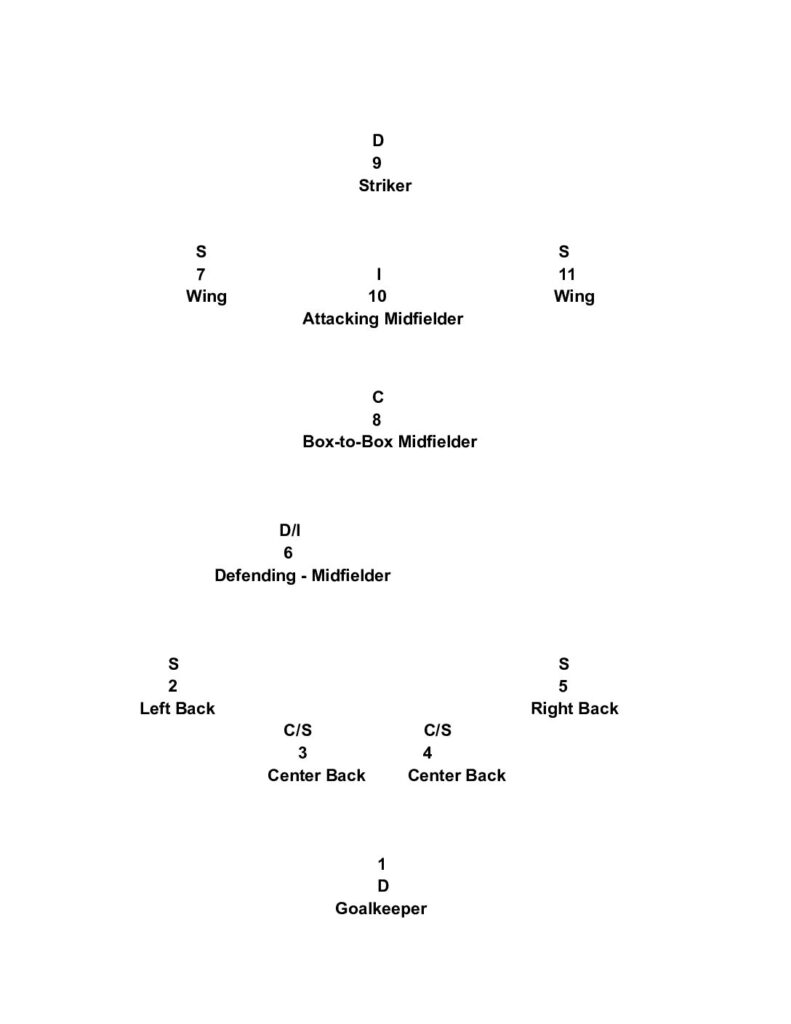
The 4-4-2 and the DISC

Our thesis is that applying the DISC model will help coaches and players alike get more satisfaction and better overall team success by playing each player at the position they naturally feel best suited. —

Please remember most people don’t have only one personality style, but a conglomerate of two or three of the four personality styles.   The study of personality and behavior is very complex.  Human beings are complex.  Humans under stress are even more complex.  

What we call a personality style is really a behavior style.  A style of hardwired predictable behavior patterns that — while predictable — are utilized uniquely by every person.  

Remember that every player (no matter their personality style) will bring something positive as they play each field position.  However, players will find the most success playing a position that matches their natural behavior patterns.  

Successful players always play to their strengths, but always remember they are only as good as their weaknesses.  This means as a player you should focus on what you do best, but remember your blindspot is what will get you into trouble. 

Let’s start with the forward field positions.

Striker – D

The striker is a player with nerves of steel. The striker has a laser focus on the goal and putting the ball to the back of the net no matter what or who stands in her way.  The “D” of the striker is what stokes her fire to win. 

Wing – S

The wing’s job is to support the play by getting the ball back into position to score.  “S” style players are excited by their support role.   They are as proud to earn an assist, as with the resulting goal that was scored.

Attacking Midfielder – I

The word attack implies action.  The attacking midfielder has to be action oriented, but creative in their play to open up opportunities for their fellow forward teammates. An I personality style are both suited for action. “I’s” are action oriented and love to use a creative approach in order to stand out amongst the team.  We prefer the notion of having an I in this position as a “D” player may take it upon themselves to shoot the ball each touch without waiting for a better play to emerge.

Box-to-Box Midfielder – C

The Box-to-Box Midfielder’s ball handling skills have to be technically precise.   In  addition to having the best ball handling chops, this player must possess a tactician’s ability to analyze the action on the entire pitch and logically surmise where their skills can be best utilized at any time to best support the team.  The depth of game knowledge, skill level, and stamina required of the B-2-B Midfielder isn’t just offense or defense, but both.  

Defending Midfielder – D/I

The Defending Midfielder requires the mental and internal fortitude to face down an oncoming freight train of opposing players and break up their play to regain possession.  

Left Back & Right Back – S

Just as the Wings act in a supportive role on the offensive side of the pitch, Left Backs and Right Backs support the defense in getting the ball away from the goal and on to a downfield team member.  “S’s” do their best work in supportive roles and receive a sense of accomplishment from being supportive.  However, it never hurts to remind the players in supportive roles how valuable they are to the success of the team.  

Center Backs – C/S

The Center Back position can be filled with “C’s” or “S’s”.  “C’s” are preferable because of their skills in analyzing and logically thinking through oncoming attacks.  Once a “C” has analyzed the opposing players and because they are so task-oriented, they have the ability of being an immovable, difficult obstacle to overcome on the way to the goal.

Goalkeeper – D     

What makes an excellent goalkeeper?  Extraordinary big hands?  A large wingspan? 

We suggest that the biggest trait of successful goalkeepers is nerve.  A goalkeeper must have the inner fortitude to face down two tons of charging, snorting rhinoceros on the plains of the Serhengetti and not lose their nerve.  “D’s” have the ability to face these challenges and come out victorious because their need for dominance is wrapped up in their identity.  A “D” would rather die than face the humiliation of someone getting the better of him.

Goalkeepers have the immense pressure of standing alone, in the box during end-of-game penalty kicks knowing that everything rides on her.  “D’s” love this challenge and pressure because it gives them a chance to show everyone (including themselves) what they are made of.     

Default Aggressive vs. Default Team

Former Navy Seal Jocko Willink  talks about the need to be “default aggressive.”  When it comes to the DISC model, the “I-S-C” players should be encouraged to “default aggressive.”  However, an already extremely aggressive “D” may need to rein-in their “D” to become “default team.”  A showboating “I” may also need to think “default team” before thinking default me.  “Default team” is thinking about the good of the team before thinking about yourself.  

An example of “default team” mentality could be after a questionable call is made by the ref instead of getting in his face and risking expulsion, the “D” takes a deep breath, shakes his head, and walks the other way.  This keeps the team’s striker on the pitch and ready to score the game-winning goal, instead of watching helplessly from the sidelines.     

Young players need to understand their personality style because it develops a better sense of who they are and in turn,  increases self-confidence.  The more self-confident the player, the more successful the player.  As a coach, understanding your players’ personality styles better helps you know where to place them on the field for both the success of the player and the overall success of the team.